
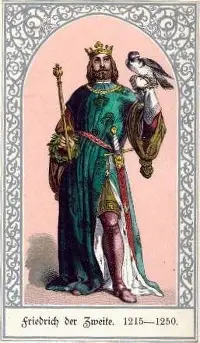
Few figures in human history are as extraordinary as the grandson of Frederick Barbarossa, founder of the Holy Roman Empire, and son of Emperor Henry VI of Swabia. His father, Count Roger, had arranged a marriage to unite his Hohenstaufen empire with the Norman dynasty of Roger II, the first king of Sicily after his father, Count Roger, expelled the last Moors from the island. The Moors had ruled Sicily as the Emirate of Sicily for nearly 200 years, from the capture of Taormina in 902 until the fall of the last Saracen stronghold to Norman troops in the walled city of Noto in 1091.
The marriage of Constance I, daughter of the Norman Roger II, to Henry VI Hohenstaufen, son of Frederick Barbarossa, in 1186, united these two powerful families: the German Swabians with the Norman Villalta (Hautville in French). It was the wedding of the century. What mattered at that time were the alliances of kings and princes, with little regard for the feelings or attraction of the couples, which in much of the world are the key to starting married life today, especially in the West. Frederick II, the son of that royal couple, was 14 years old, and his wife, Constance of Aragon—daughter of the kings of Castile and Aragon—was 30, but they answered the call of their parents and grandparents to continue the unification of both kingdoms.
Barbarossa’s leadership was undisputed: he organized the Third Crusade, one of the eight that attempted to recapture the Holy Land—specifically Jerusalem, Nazareth, and Bethlehem—from Muslim hands, alongside King Henry II of France and Richard I of England, better known as Richard the Lionheart. Richard was a Plantagenet, born in Oxford but raised in France, and more French than anything else: he spoke little English, only Occitan and French, and lived in England for only six months of his eventful 41 years. Barbarossa, for his part, did not reach the Middle East on his ambitious crusade, as he died at the age of 68, drowning while crossing a river on horseback in Turkey. It is said that the weight of his armor prevented him from surviving the crossing.
Speaking of the Third Crusade, known as the Kings’ Crusade, they were fighting alongside another extraordinary man, Saladin— Salah ad-Din , meaning “the uprightness of the faith”—who had captured Jerusalem after 88 years of Christian rule in the crushing Battle of Hattin in 1187. Of course, in those days, fighting was a fight to the death, though we might even say it was more noble in the sense that battles were generally hand-to-hand combat, unlike today’s war of attrition, which was aided by the use of catapults, battering rams, incendiary devices, bows, arrows, and other clever war machines. In fact, when Saladin learned that King Richard the Lionheart had lost his horse in battle, he sent him two magnificent Arabian stallions, famously declaring, “A king cannot fight on foot.” Saladin’s generosity was such that, upon learning Richard was very ill—perhaps from scurvy or some severe infection—he brought him ice from the mountains and fresh fruit to his camp to aid his recovery. Richard’s illness grew increasingly severe, and the chronicles of the time say he lost his nails and hair. He did not die on the Third Crusade, however, but from gangrene at the age of 41 in 1199, in his beloved Aquitaine, France, in the arms of his mother, Duchess Eleanor, the future Queen of England and France.
In Sicily, the 200 years of Muslim rule influenced many people to adopt the name “Saladin” as a sign of prestige and honor, even if they had no direct lineage from the sultan who founded the Ayyubid dynasty. This man, who, unlike so many Christian Templars who acted savagely, robbing and murdering without the slightest remorse, ordered his soldiers not to desecrate Christian temples, allowed Christian prisoners to buy their freedom, and even permitted them to pray in their “holy places,” despite being under Islamic rule. Such was his reputation as an honorable man that Dante Alighieri placed Saladin in “Limbo” in his masterpiece, The Divine Comedy, that place for righteous souls who had not been baptized but who possessed great nobility, like this great unifier of Islam.
Equally extraordinary was the fact that Frederick II Hohenstaufen, who led the Sixth Crusade, did so peacefully and diplomatically, as never before seen in medieval history. He achieved a peace treaty with the Sultan of Egypt, al-Kamil, also of the Ayyubid dynasty. The Treaty of Jaffa allowed Frederick to reclaim these sites for Christendom without bloodshed, also granting freedom of worship to Muslims and permitting their visits to the Dome of the Rock and the al-Aqsa Mosque. This land, still so full of hatred and violence today, experienced a fleeting oasis of peace.
Since Frederick II had achieved these peace agreements in 1229 with the Egyptian sultan without bloodshed, the crusaders flatly rejected them, arguing that Jerusalem could not be won without bloodshed… Meanwhile, Pope Gregory IX organized an army to remove Frederick from his reign in Sicily, failing completely when the emperor returned to the island and defeated the papal armies and the barons who had conspired against him. The Pope finally lifted the excommunica and a peace agreement was signed, the famous Treaty of San Germano of 1230, by which Frederick II achieved his grandfather’s rehabilitative dream, that is, the recognition of the Holy Roman Empire as sacred, the dream of the historical founder of the empire and unifier of all the Germanic tribes, Otto I, in 962. The Church, for its part, obtained independence in the selection of its bishops, exemption from paying taxes and the creation of ecclesiastical courts to judge the members of the curia, instead of common courts of justice.
Years of peace and great success followed for this extraordinary man, so educated and multilingual that he spoke six languages, including Arabic, and who went down in history with the nickname Splendor Mundi, the wonder of the world… The eccentricities that surrounded him also added to the myth. For example, Frederick II, excommunicated like his grandfather Barbarossa, liked to dress in oriental clothing, traveled through Europe with his entourage of international advisors and a harem of between 20 and 50 women of various ethnicities—white, Saracen, and oriental—provoking the anger of many religious figures of the time. Moreover, his caravan was, to put it mildly, like a circus: it included the elephant and giraffe that Sultan al-Kamil had given him, as well as panthers, lions, polar bears, camels, falcons, and leopards trained for hunting—a spectacle of splendor and magnificence that was completely unusual for the 13th century.
As death did not stop figures like Emperor Frederick II Hohenstaufen, the reopening of his magnificent tomb in 1781, located in the Norman Palace in Palermo, the current seat of the Regional Parliament of Sicily, revealed that in addition to the remains of his great-grandson, Peter II of Sicily—which was not unusual at the time, since there was no tomb worthy of Peter’s rank when he died suddenly in 1342—the body of a woman also lay beside the great emperor, possibly his favorite mistress, Bianca Lancia, or perhaps a princess of the House of Aragon belonging to Peter’s lineage. In short, a man who was a subject of much discussion throughout his life and even after his death, definitely deserving of the nickname: “The Wonder of the World,” Splendor Mundi .
